
Adaptive Wildlife Management
Managing with Uncertainty
Wild ungulate management takes place in a complex and changing system. Wildlife populations, ecosystems and human activities interact in ways that cannot be fully predicted or controlled. As a result, management decisions inevitably involve uncertainty.
Adaptive management embraces this uncertainty rather than ignoring it. It is a structured, iterative approach based on learning by doing: management actions are implemented, their outcomes are monitored and evaluated, and what we learn is used to improve future decisions.
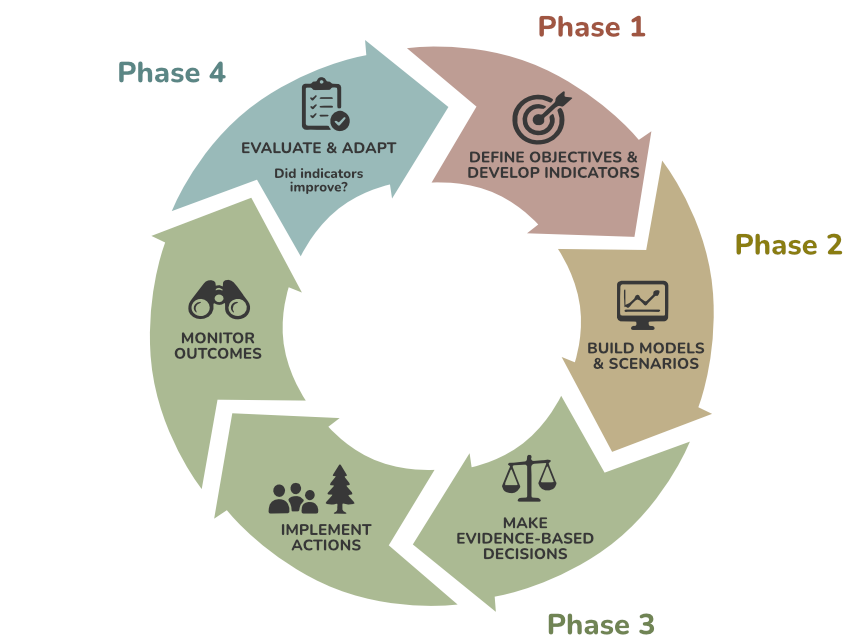
This creates a flexible cycle of act, monitor, learn and adapt, allowing management strategies to be continuously evaluated and refined as new knowledge becomes available.
Rather than aiming to eliminate uncertainty, adaptive management makes it explicit and supports better decisions by quantifying uncertainty and risk.
The Process
Phase 1
DEFINE OBJECTIVES &
DEVELOP INDICATORS
- Outline current challenges.
- Define clear, measurable, common management objectives in line with biodiversity and societal values.
- Identify key indicators for wildlife populations, ecosystems, and human dimensions.
Phase 2
BUILD MODELS & FORECAST ALTERNATIVE SCENARIOS
- Define available data and run population models.
- Use models to explore future scenarios and uncertainties.
Phase 3
MAKE EVIDENCE-BASED DECISIONS, IMPLEMENT & MONITOR OUTCOMES
- Evaluate trade-offs, select the best management options based on evidence, develop adequate protocols.
- Apply management actions in the field (e.g. harvest plans, habitat measures,…).
- Collect and analyse data (on the field and human dimension) to asses the effects of actions and external drivers.
Phase 4
EVALUATE, LEARN & ADAPT
- Asses outcome of management actions.
- Learn from results and adapt objectives, strategies, and actions accordingly.
- Repeat.
The Work Packages
Tools for an Adaptive Management.
WP 1
xxx
- List 1
- List 2
WP 2
xxx
- List 1
- List 2
WP 3
xxx
- List 1
- List 2
WP 4
xxx
- List 1
- List 2